
Screen Time and Brain Development: What the White Matter Research Really Shows
In 2019, researchers at Cincinnati Children's Hospital asked 47 preschoolers to lie still, awake, inside an MRI scanner. They wanted to explore a question many parents wonder about: is there a connection between screen time and brain development in the earliest years?
What they found made headlines. Children whose screen use went further beyond pediatric guidelines tended to have different readings in the brain's "wiring," the pathways that support language and early reading.
It's an important finding, and an easy one to misread. Here's what the research shows, what it doesn't, and what it means for your family.
What Is White Matter, and Why Does It Matter?
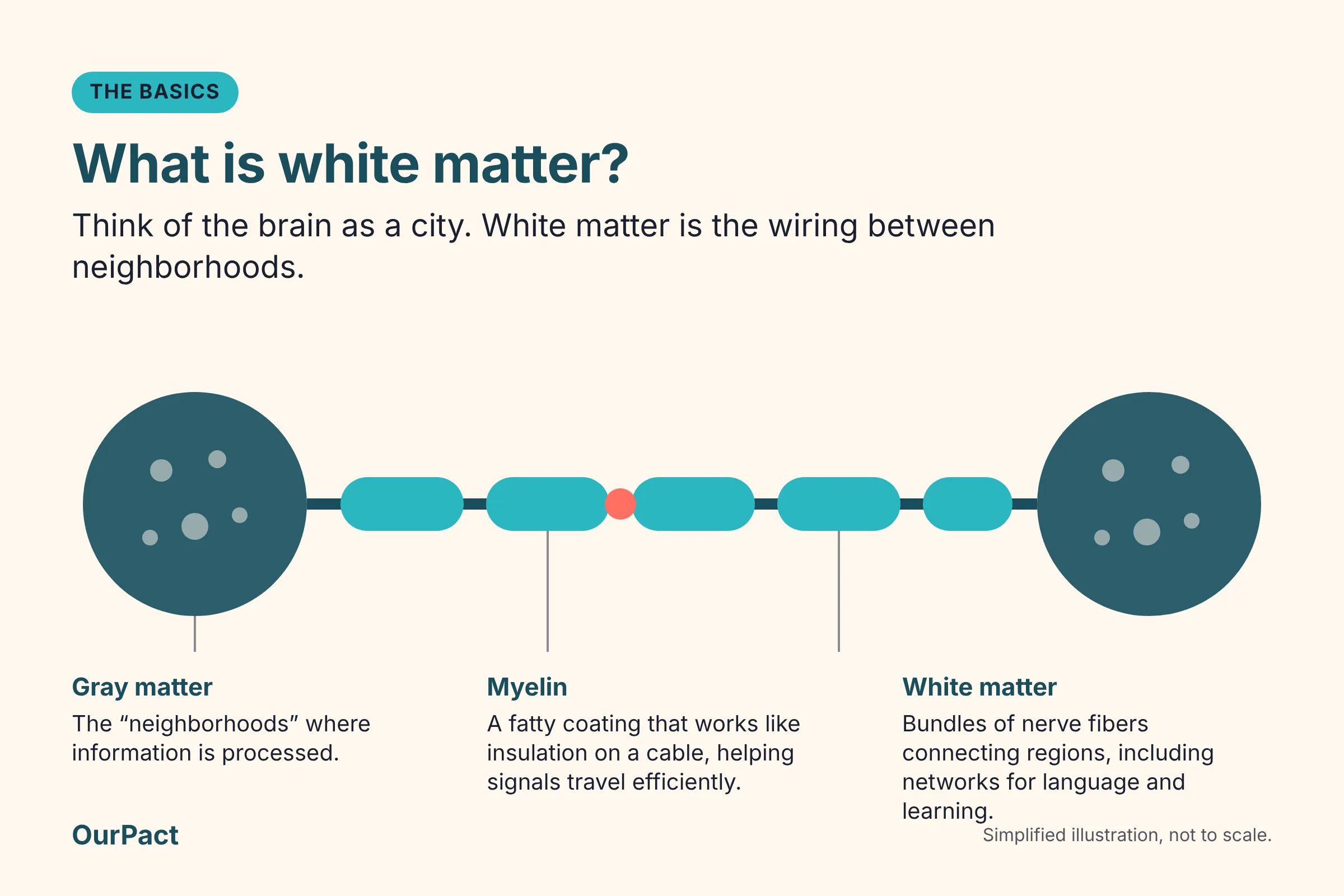
Think of the brain as a busy city. Gray matter holds the neighborhoods where information gets processed. White matter is the network of cables connecting them, so signals can travel from one area to another.
Much of that wiring is wrapped in myelin, a fatty coating that works like the insulation around an electrical cable and helps signals move efficiently. In early childhood, these pathways grow, organize, and gain insulation. Researchers describe this process as highly sensitive to a child's environment (Hutton et al., JAMA Pediatrics).
White matter development in children matters because these pathways link brain networks involved in language, learning, and the planning and focus skills called executive function. One study of 68 preschoolers found that "structural markers for language performance are apparent as young as 3 years of age" (Walton, Dewey & Lebel, Brain and Language, 2018).
Keep in mind, though, that a brain scan measurement is not a report card. No single imaging number determines a child's intelligence or school success.
What the Featured Study Found About Screen Time and White Matter
The study, led by pediatrician Dr. John Hutton with Jonathan Dudley, Tzipi Horowitz-Kraus, Tom DeWitt, and Scott Holland, was published in JAMA Pediatrics (online in 2019).
How the researchers studied it
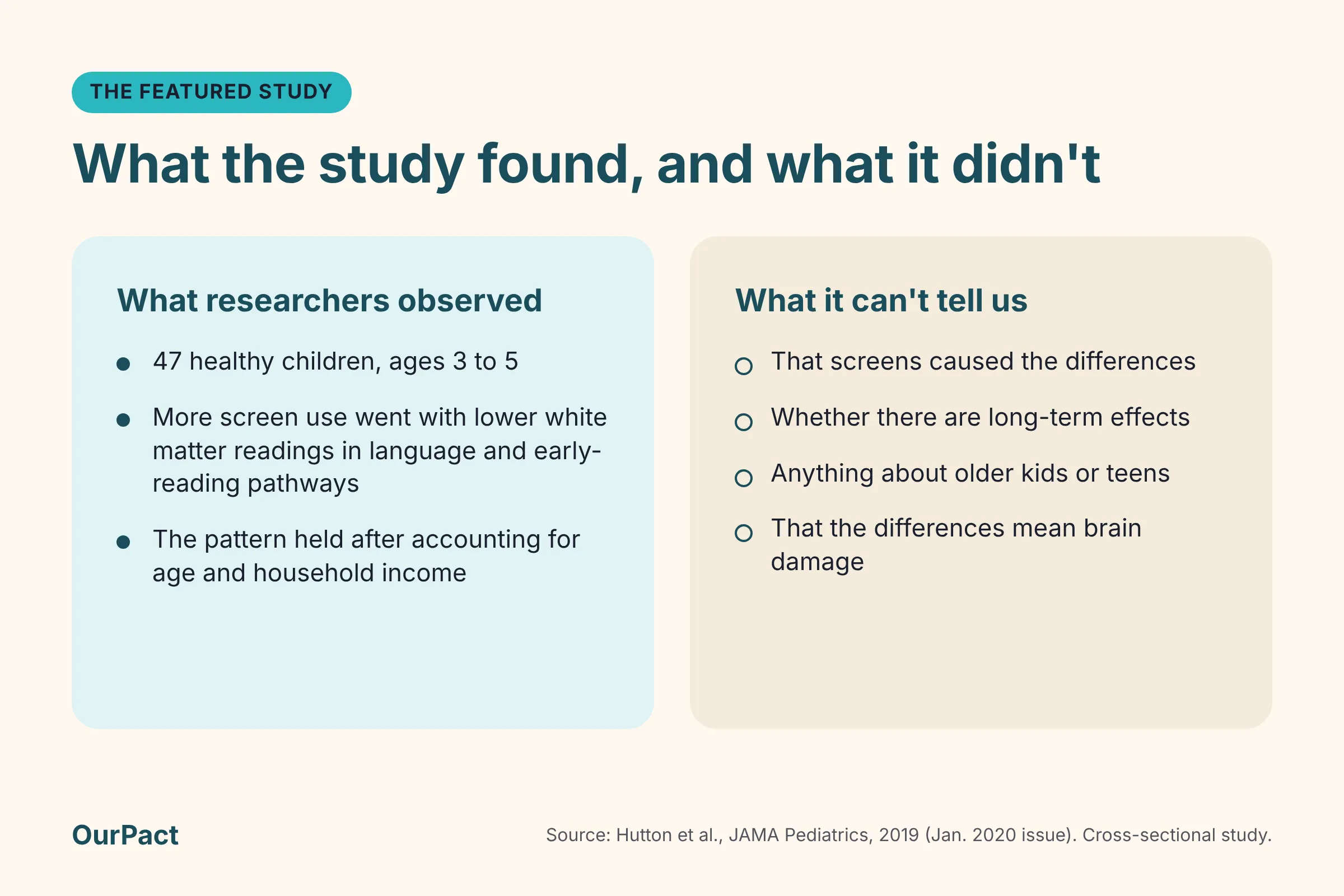
- Who took part: 47 healthy children ages 3 to 5, mostly from middle- to higher-income families.
- Screen use: Parents completed a 15-question survey, ScreenQ, covering access (such as devices in the bedroom), frequency, content, and whether a parent watched along. Higher scores meant use further above American Academy of Pediatrics recommendations.
- White matter: Diffusion tensor imaging, an MRI method that estimates how organized and insulated white matter pathways are.
- Skills tested: Vocabulary, rapid naming, and early reading readiness.
What they observed
Children with higher screen-use scores tended to have lower measures of white matter organization in pathways supporting language and emerging literacy, even after accounting for age and household income.
Higher scores were also linked to lower vocabulary, naming, and early reading results, but those links were no longer statistically significant once family income was considered.
What the study could not establish
This is the part headlines often skip. The study captured a single moment in time, so it can't show that screens caused the differences. The authors wrote that their findings are "correlational in nature and do not identify causality or long-term developmental risks."
They also raised a key open question: do the differences come from screen media itself, or from what screen time replaces, such as reading and conversation? They considered both plausible.
The sample was small and mostly higher-income, and screen use was reported by parents. Because the children were preschoolers, the results shouldn't be applied to older kids or teens. The authors concluded: "The findings suggest further study is needed, particularly during the rapid early stages of brain development."
In other words, this is an early, valuable signal. It is not proof of brain damage.
How Screen Time Affects Brain Development: What Other Research Reveals
Studies that followed children over time
A Canadian study of more than 2,400 children found that more screen time at ages 2 and 3 predicted slightly lower developmental screening scores a year or two later, but not the reverse (Madigan et al., JAMA Pediatrics, 2019). The effects were small, and the study was observational.
In Singapore, babies with more screen time at 12 months showed different brain-wave activity at 18 months and weaker attention and executive function measures around age 9 (Law et al., JAMA Pediatrics, 2023). The authors cautioned that family factors may also play a role. For more on timing, see When Screen Time Matters Most.
How kids use screens may matter as much as how much
A 2024 review of 100 studies of children under 6 found that context matters (Mallawaarachchi et al., JAMA Pediatrics, 2024). Using screens together with a caregiver was linked to better cognitive outcomes, while background TV and heavier program viewing were linked to poorer ones. Several other kinds of use showed no clear link, and overall effects were small to moderate.
Conversation may be part of the story. Among 4- to 6-year-olds, more back-and-forth talk with adults was linked to stronger connections between the brain's language areas, regardless of family income (Romeo et al., Journal of Neuroscience, 2018).
The picture for older kids and teens is more mixed
- Brain development: A large U.S. study following about 10-year-olds for four years found overall digital media use did not change how the brain's cortex developed (Nivins et al., Scientific Reports, 2024).
- Well-being: Across more than 355,000 adolescents, technology use explained at most 0.4% of differences in well-being (Orben & Przybylski, Nature Human Behaviour, 2019).
- Reading: In early adolescents, screen use was linked to weaker language skills, partly by crowding out reading (Li et al., Advanced Science, 2024).
- Sleep: Across 17 studies of kids ages 6 to 18, bedtime device access and use were linked to less and poorer sleep (Carter et al., JAMA Pediatrics, 2016).
So there is no scientific consensus that screens harm the brain. Age, content, timing, and what screens replace all shape the picture.
What Does This Mean for Parents?
You don't need a final scientific verdict to make thoughtful choices. The research suggests screens may matter partly because of the time they take from other things. So it's worth protecting time for:
- Sleep
- Physical activity and outdoor play
- Face-to-face conversation
- Reading and offline learning
- Family connection
- Age-appropriate independence, so older kids can practice managing their own time
For young children, the World Health Organization recommends no sedentary screen time for babies and 1-year-olds. For ages 2 to 4: "Sedentary screen time should be no more than 1 hour; less is better."
No study has shown that limiting screen time repairs or improves white matter. These are sensible habits grounded in what we know, not a brain treatment.
Practical Tips for Healthy Screen Time Limits for Kids
These are practical parenting strategies. Where research supports one, we've noted it.
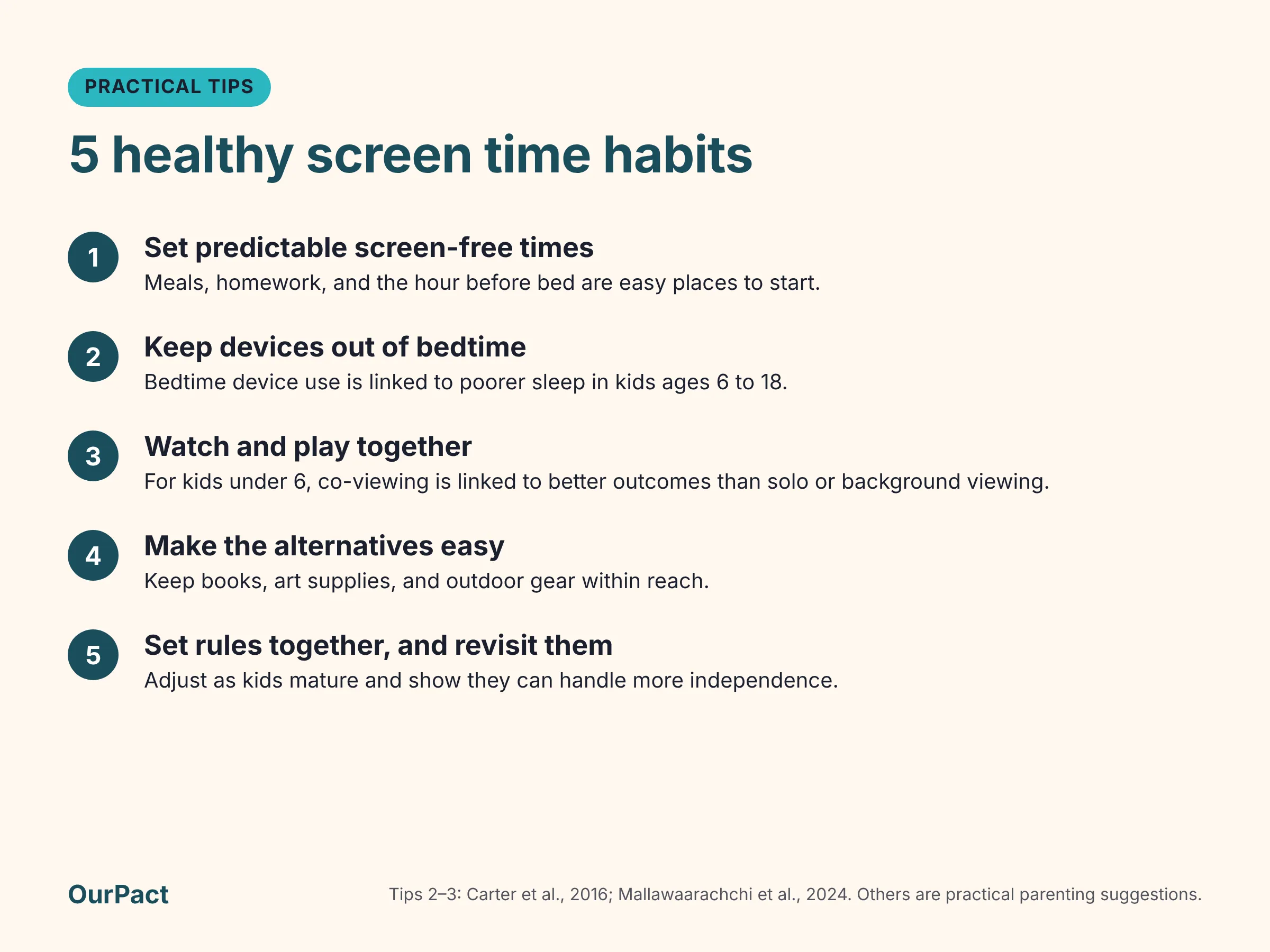
- Set predictable screen-free times. Meals, homework, and the hour before bed are natural starting points, and predictability means fewer negotiations.
- Keep devices out of bedtime. Charging devices outside the bedroom is a research-backed habit for older kids' sleep (Carter et al.).
- Watch and play together when you can. For young children, co-viewing is linked to better outcomes than solo or background viewing (Mallawaarachchi et al.).
- Make the alternatives easy. Keep books, art supplies, and outdoor gear within reach.
- Set rules together, and revisit them. Talk with kids about which apps feel distracting, and adjust the rules as they mature.
How OurPact Helps Families Establish Healthy Digital Boundaries
Good intentions are easier to keep with the right support. OurPact is a parental control app for screen time that helps families turn agreed-on expectations into consistent routines:
- Screen time schedules: Recurring schedules automatically limit app access during homework, meals, or bedtime.
- Screen time allowance: A daily amount of screen time lets kids practice managing it themselves.
- App Rules: Block, allow, or schedule individual apps, such as games or social media.
- Instant Block and Grant: Pause access with a tap at dinnertime, or grant extra time when the day calls for flexibility.
OurPact isn't a medical or developmental treatment. It's a parenting tool that works best alongside clear expectations and supportive conversations, so boundaries feel like a shared plan rather than a punishment.
Helping Kids Build a Healthier Relationship With Technology
Research on screen time and kids' brains is still evolving. Early findings like the white matter study deserve attention and careful reading: they show links, not proof, and much depends on age, content, and context.
If your child already uses screens, you haven't done anything wrong. Screens are part of modern family life. What you can do, starting today, is make sure they leave room for sleep, play, conversation, and reading.
Healthy screen habits start with thoughtful boundaries. OurPact gives parents the tools to manage screen time, create consistent routines, and make room for the experiences that matter most. Start your 14-day free trial of OurPact and discover a simpler way to bring balance to your family's digital life.
Frequently Asked Questions
Does screen time damage children's brains?
Current research doesn't show that. A 2019 study of preschoolers found higher screen use was associated with differences in white matter measures, and the authors stressed the findings are correlational. Imaging differences are not damage.
How much screen time is healthy for young kids?
The World Health Organization recommends no sedentary screen time under age 2 and no more than one hour a day for ages 2 to 4, with less being better. For older kids, many families focus on protecting sleep, activity, and family time rather than a single number.
Is screen time bad for teenagers' brains?
The evidence is mixed. A large study following 10-year-olds for four years found overall digital media use didn't change cortical development, while bedtime device use is linked to poorer sleep in school-age kids and teens.
References
1. Hutton JS, Dudley J, Horowitz-Kraus T, DeWitt T, Holland SK. Associations between screen-based media use and brain white matter integrity in preschool-aged children. JAMA Pediatrics. 2020;174(1):e193869. https://jamanetwork.com/journals/jamapediatrics/fullarticle/2754101
2. Walton M, Dewey D, Lebel C. Brain white matter structure and language ability in preschool-aged children. Brain and Language. 2018;176:19–25. https://doi.org/10.1016/j.bandl.2017.10.008
3. Madigan S, Browne D, Racine N, Mori C, Tough S. Association between screen time and children's performance on a developmental screening test. JAMA Pediatrics. 2019;173(3):244–250. https://jamanetwork.com/journals/jamapediatrics/fullarticle/2722666
4. Law EC, Han MX, Lai Z, et al. Associations between infant screen use, electroencephalography markers, and cognitive outcomes. JAMA Pediatrics. 2023;177(3):311–318. https://jamanetwork.com/journals/jamapediatrics/fullarticle/2800776
5. Mallawaarachchi S, Burley J, Mavilidi M, et al. Early childhood screen use contexts and cognitive and psychosocial outcomes: a systematic review and meta-analysis. JAMA Pediatrics. 2024;178(10):1017–1026. https://jamanetwork.com/journals/jamapediatrics/fullarticle/2821940
6. Romeo RR, Segaran J, Leonard JA, et al. Language exposure relates to structural neural connectivity in childhood. Journal of Neuroscience. 2018;38(36):7870–7877. https://doi.org/10.1523/JNEUROSCI.0484-18.2018
7. Nivins S, Sauce B, Liebherr M, Judd N, Klingberg T. Long-term impact of digital media on brain development in children. Scientific Reports. 2024;14:13030. https://doi.org/10.1038/s41598-024-63566-y
8. Orben A, Przybylski AK. The association between adolescent well-being and digital technology use. Nature Human Behaviour. 2019;3:173–182. https://doi.org/10.1038/s41562-018-0506-1
9. Li M, Zhao R, Dang X, et al. Causal relationships between screen use, reading, and brain development in early adolescents. Advanced Science. 2024;11(11). https://doi.org/10.1002/advs.202307540
10. Carter B, Rees P, Hale L, Bhattacharjee D, Paradkar MS. Association between portable screen-based media device access or use and sleep outcomes: a systematic review and meta-analysis. JAMA Pediatrics. 2016;170(12):1202–1208. https://jamanetwork.com/journals/jamapediatrics/fullarticle/2571467
11. World Health Organization. To grow up healthy, children need to sit less and play more. News release, April 24, 2019. https://www.who.int/news/item/24-04-2019-to-grow-up-healthy-children-need-to-sit-less-and-play-more

Related Blog Posts



Manage Screen Time. Protect Your Family. Stay Connected.
OurPact makes digital parenting simple. Set app schedules, block distractions, and guide your kids toward smarter tech use, all in one easy-to-use app.