
When Screen Time Matters Most: What New Research Tells Parents
When Screen Time Matters Most: What New Research Tells Parents
Most screen time advice starts and ends with a number. Two hours. One hour. None before age two. Parents dutifully try to hit the target, feel guilty when they miss it, and are left with the nagging sense that the number isn't really the point.
Two significant research updates in 2026 suggest that instinct is correct. A long-running birth cohort study found that when children encounter screens may matter as much as how much, and a newly updated expert review from Johns Hopkins Medicine makes clear that for teenagers, what they're doing on screens matters more than the raw total.
Here's what both say, and what it means for the way you actually run your household.
Does the age a child uses screens matter more than the amount?
Research increasingly suggests it matters a great deal and that two windows stand out.
A study published in the World Journal of Pediatrics in April 2026, led by researchers at Inserm and the National University of Singapore, followed 502 children in the Growing Up in Singapore Towards healthy Outcomes (GUSTO) cohort. Parents reported screen time at six points between ages 1 and 8. Years later, psychologists measured academic performance at age 9 and working memory at age 10.5.
The pattern that emerged was not a straight line. Screen exposure during infancy showed the strongest links to weaker later academic performance and working memory, the researchers noted the effect sizes at age 1 were the largest of any point they measured. The associations then faded at ages 2 and 3. And then, unexpectedly, they returned around age 6, as children entered formal schooling.
The authors were candid that this second spike surprised them. Their suggested explanation for infancy is intuitive once you hear it: babies build language, attention, and social understanding through back-and-forth interaction with a caregiver's face. Screen time in that window doesn't just add something — it displaces the thing the developing brain most needs. School entry appears to be a second period of rapid cognitive reorganization where the same displacement carries unusual weight.
A separate GUSTO analysis using brain imaging pointed in a similar direction, associating high screen exposure before age two with differences in how visual-processing and cognitive-control networks matured, and with slower reaction times and higher anxiety measured years later.
What this means at home: If you have limited energy for screen rules — and every parent does — spend it disproportionately in the first two years and in the kindergarten-through-first-grade stretch. A relaxed policy during the preschool years is a much smaller risk than a relaxed policy at 12 months or at 6.
It's also worth saying plainly: these are associations, not proof of cause. The researchers themselves frame the takeaway as "less is better" at a population level rather than a prediction about any individual child. An extra hour of cartoons did not doom your kid.
What does the research say about teens and social media?
That "sweet spot" framing comes from the Johns Hopkins Medicine expert Q&A, updated in July 2026, drawing on child and adolescent psychiatrist Carol Vidal, M.D., Ph.D., M.P.H., and Jennifer Katzenstein, Ph.D. It matters because it cuts against the instinct to find one correct number and apply it. Depression rates run high at both very low and very high social media use — which means the right amount genuinely differs by child, developmental stage, and what else is going on in their life.
The Hopkins review is two-sided, and the positives deserve equal billing.
What social media does well
It provides access to information young people may not find anywhere else, a place to express themselves, and a way past barriers like distance or shyness. Survey data cited in the review found 74% of teens agreed social media made them feel more connected to their peers. Vidal notes that many kids find a community more accepting of who they are than their immediate family or school offers. Platforms can also encourage help-seeking — prompting a teen toward mental health care, affirming identity, providing social support, and buffering stress.
Where the risks concentrate
The review cites the 2023 U.S. Surgeon General advisory, which noted that frequent use is associated with changes in brain regions tied to impulse control, social behavior, emotional regulation, and sensitivity to social rewards and punishments. It also describes reward-system overstimulation resembling addiction: dopamine signals during scrolling and posting create positive reinforcement that pulls young people back, in a loop that is genuinely hard for an adolescent to break.
The mechanisms Hopkins identifies as most likely to connect heavy use with worse mood are worth knowing, because each one is actionable:
- Sleep loss. Scrolling raises stress, "a few minutes" becomes hours, and blue light interferes with sleep patterns. Sleep deprivation is itself a well-established contributor to depression.
- Displaced activity. Physical activity and outdoor time release endorphins and build a sense of accomplishment. Time on social media can quietly crowd both out.
- Social isolation. Kids spend less time with friends and family in person than past generations, and watching others socialize without you can deepen the feeling of exclusion rather than relieve it.
- Social comparison. Measuring a real life against other people's projected ones erodes self-esteem, especially when the comparison is constant.
- Cyberbullying. It's easier to stay anonymous online, and easier for parents to miss. Notably, Hopkins points out that kids often don't tell parents — because they fear losing device access, or fear consequences for being somewhere they weren't supposed to be.
That last point has a direct implication for how you write your household rules, and we'll come back to it.
Beyond total hours: three questions that matter more than a stopwatch

Beyond total hours: what actually makes screen time better or worse?
The GUSTO authors explicitly flagged the next frontier: not just duration, but content quality, device type, and whether a parent is watching alongside. Three questions do more work than a stopwatch.
1. What is it replacing? This is the single most useful lens, and it's the mechanism behind the infancy finding. An hour of a show after homework, with the family in the room, replaces almost nothing. An hour that replaces sleep, outdoor play, a meal together, or conversation with a caregiver is a different hour entirely. Ask what got displaced, not what got watched.
2. Is anyone watching with them? Co-viewing changes passive consumption into shared experience. For young children it restores the back-and-forth interaction that screens otherwise displace. For teens, watching or playing something together is one of the few reliable ways to see what your kid actually engages with — without reading over a shoulder.
3. Is it active or passive? Creating, messaging a known friend, or building something occupies a different category from infinite-scroll feeds engineered to be difficult to stop. The reward loop Hopkins describes is a design property of certain formats, not of screens generally.
What can parents actually do?
The Johns Hopkins guidance is unglamorous and practical. Adapted, with a few additions:
Model it yourself. Hopkins is blunt on this: children and teens emulate what they see far more than what they're told. A parent scrolling through dinner while enforcing a no-phones rule teaches the rule is about power, not health. This is the least popular recommendation in every screen time article and the most important one.
Talk about the downsides directly. Not as a lecture but as information. Teens who understand why a feed is hard to put down tend to be better at noticing when it's happening to them.
Build phone-free hours and spaces. Bedrooms overnight and mealtimes are the highest-yield two, because they protect sleep and in-person connection, the two mechanisms most strongly implicated above. Make them household-wide, adults included.
Turn off notifications. One of the highest-leverage, lowest-conflict changes available. It removes the interruption without removing the app.
Take regular breaks. Framed as normal maintenance rather than punishment.
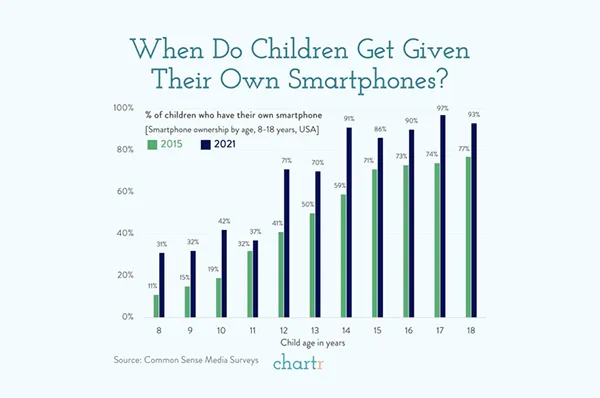
Delay the first smartphone. Vidal recommends waiting until the child is ready as a good first step, while stressing that delay isn't a strategy on its own, since technology will be part of their life regardless. The goal is a healthy relationship with it, which she compares to learning a healthy relationship with food or exercise.
Discuss what it means to be a good citizen online. Katzenstein's framing is useful for kids: don't post anything you wouldn't say to someone's face in the real world.
Three conversation openers that tend to work
Scripts help when the topic has become a fight. These aim for curiosity rather than interrogation:
"What's something you saw today that was actually good?" — Signals that you don't assume everything online is harmful, which makes you safer to bring problems to.
"Do you ever open an app and then wonder where the last hour went? That happens to me too." — Names the reward loop without accusation and puts you on the same side of it.
"If something happened online that upset you, I want to know — and you're not going to lose your phone for telling me." — This one is worth saying out loud and meaning it. Hopkins specifically notes that fear of losing device access keeps kids from reporting cyberbullying. A rule that punishes disclosure will reliably produce silence.
Where parental control apps fit ... and where they don't
Honestly: as scaffolding, not as a solution.
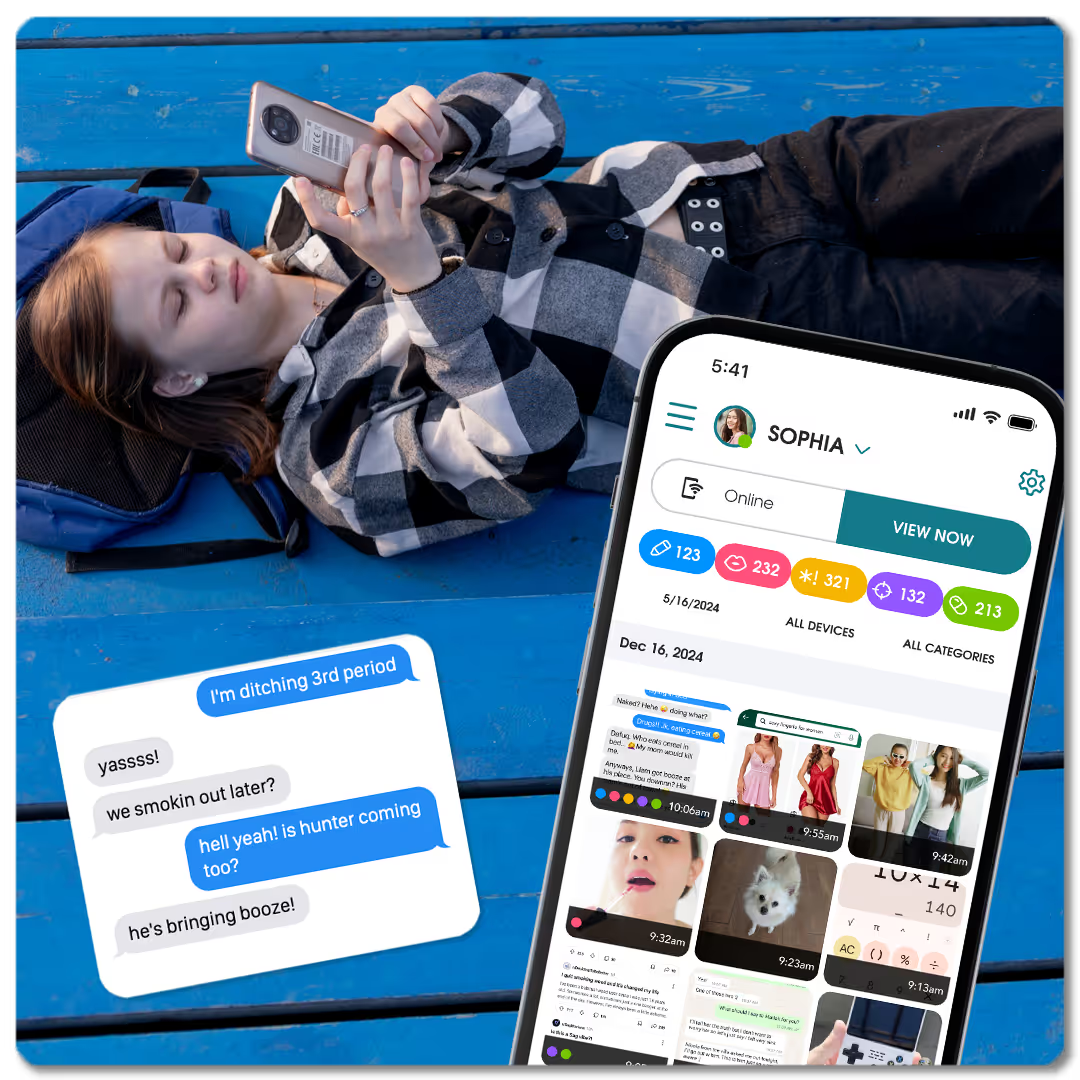
Structured limits and monitoring are one practical way to protect the things the research keeps pointing at like sleep, time for play and outdoor activity, and exposure to content that isn't serving your child. Parental media monitoring has been associated in various studies with better sleep, healthier weight, and better grades. Schedules, app blocking, content insight, and location features can hold a boundary without requiring a parent to relitigate it every evening, which reduces conflict rather than creating it.
But the framing that matters is guardrails or training wheels. Most experts treat these tools as temporary supports while a child builds self-regulation, not as a permanent substitute for active parenting. Research on overly restrictive approaches without communication is fairly consistent: heavy control with no conversation can undermine trust and give kids less practice at self-regulation, not more. The tool works when it's paired with dialogue and modeling. It backfires when it replaces them.
Practically, this means using controls to enforce what you've already agreed on, a bedtime device cutoff, homework hours, a limit on a specific app ... rather than as a surveillance layer your child discovers by accident.
Two ways to set limits, and an honest note about each
There are broadly two approaches, and it's worth knowing which one you're choosing.
Change the device. Purpose-built kids' phones like Gabb, Pinwheel, Troomi and others, bake the limits into the device itself. The child never has the credentials to change them, which makes this approach very hard to work around. The tradeoffs are real too: you're buying a specific phone and usually a specific plan, it doesn't cover the iPad or the school-issued laptop already in your house, and it's a stage rather than a destination. Nearly every kid moves to a standard phone eventually.
Manage the device they have. This is what OurPact does — schedules, blocking, and monitoring layered onto the iPhone, iPad, or Android device already in your house, on either platform, adjustable as your child matures.
Here's the part we'd rather tell you than have you discover at a bad moment: software that runs on a general-purpose phone relies on that phone's operating system to hold the line, ours included. A determined, technically curious teenager has more room to work than they would on a device built from the ground up to be limited. That's a property of the approach, not a flaw in one product.
What we can promise is that they can't do it quietly. If OurPact is removed or the device is factory reset, we email the parent account. If a managed device stops checking in with our servers for 48 hours, you get an email about that too. "Impossible" is a smaller, weaker promise than it sounds — this one we can actually keep.
And it turns out visibility is the more useful thing to have. A removal you find out about is a conversation. A removal you discover three months later is a relationship problem with a long head start.
We think managing the device they already have is the right trade for most families past the first-phone stage, and the reason is the same one running through this whole article. If the goal is a seventeen-year-old who can manage themselves, they need practice, and a device that makes self-regulation structurally impossible provides none. Guardrails you can gradually loosen teach something. Guardrails that can't move don't.
Which is why the software isn't really the thing doing the work. The agreement behind it is, and the notification is what gives that agreement teeth.
For families using OurPact, we recommend pairing it with a written family agreement, one that sets clear expectations about keeping the app installed and following household device rules, with consequences you decide on as the parent. Written down, it stops being a thing you enforce and starts being a thing you both agreed to. The distinction matters more than it sounds like it should.
Download the OurPact Family Media Pact →
It's free to download or copy, and it's meant to be edited because the household rules that work for a 7-year-old and a 15-year-old aren't the same, and neither are the rules that work for two different 15-year-olds. Change the terms, the consequences, whatever you need. The value is in sitting down and filling it out together, not in the specific wording.
Frequently asked questions
Is there a safe amount of screen time?
Not a universal one. Depression rates run high at both very low and very high social media use, which is why Johns Hopkins describes a "sweet spot" that varies by child, developmental stage, and protective factors. Age matters too — the GUSTO findings suggest infancy and around age 6 are the periods where limits carry the most weight.
Does screen time cause depression in teens?
The relationship is correlational, not established as causal, and Hopkins is careful about this. Depression has many risk factors unrelated to screens. What the evidence supports is that heavy use is associated with behaviors — lost sleep, less physical activity, more social comparison, less in-person contact — that can worsen depressive symptoms.
Is social media bad for kids?
Not uniformly. It offers real benefits: connection across distance and shyness, information, identity support, and pathways to help-seeking. Roughly three-quarters of teens surveyed said it made them feel more connected to peers. The risks concentrate in heavy use and in specific formats and behaviors, not in the medium itself.
At what age should a child get a smartphone?
There's no single right answer, and Johns Hopkins frames it as readiness rather than a birthday. Delaying is a reasonable first step, but it isn't a plan by itself — habits and conversations built before the phone arrives matter more than the date it does.
Should I get a locked-down kids' phone or use a parental control app?
It depends on the stage. Purpose-built kids' phones enforce limits at the device level, which is very hard to work around. Apps manage the devices you already own, work across iOS and Android, and can be loosened as a child earns more independence. Many families use the first, then move to the second.
Are parental control apps worth it if a kid can work around them?
Yes, when paired with a family agreement and when you'd find out. OurPact emails the parent account if the app is removed or the device is factory reset, so a workaround doesn't stay hidden. The app holds the boundary day to day; the agreement makes disabling it a broken promise rather than a puzzle to solve; the notification is what tells you a promise got broken.
What's the highest-impact change I can make this week?
Devices out of bedrooms overnight, for everyone in the house. It protects sleep, the mechanism most consistently linked to mood, and the "everyone" part is what makes it stick.
If you're concerned about your child's mood, sleep, or anxiety, talk with their pediatrician or a mental health professional. This article is general information, not medical advice.
Sources
- Johns Hopkins Medicine, Social Media and Mental Health Among Children and Teens, updated July 30, 2026. hopkinsmedicine.org
- Inserm / National University of Singapore, GUSTO cohort analysis, World Journal of Pediatrics, April 2026. DOI: 10.1007/s12519-026-01046-1
- A*STAR / GUSTO neuroimaging analysis on infant screen exposure and brain network maturation, December 2025.
- U.S. Surgeon General, Social Media and Youth Mental Health advisory, 2023.
Related Blog Posts


Manage Screen Time. Protect Your Family. Stay Connected.
OurPact makes digital parenting simple. Set app schedules, block distractions, and guide your kids toward smarter tech use, all in one easy-to-use app.